
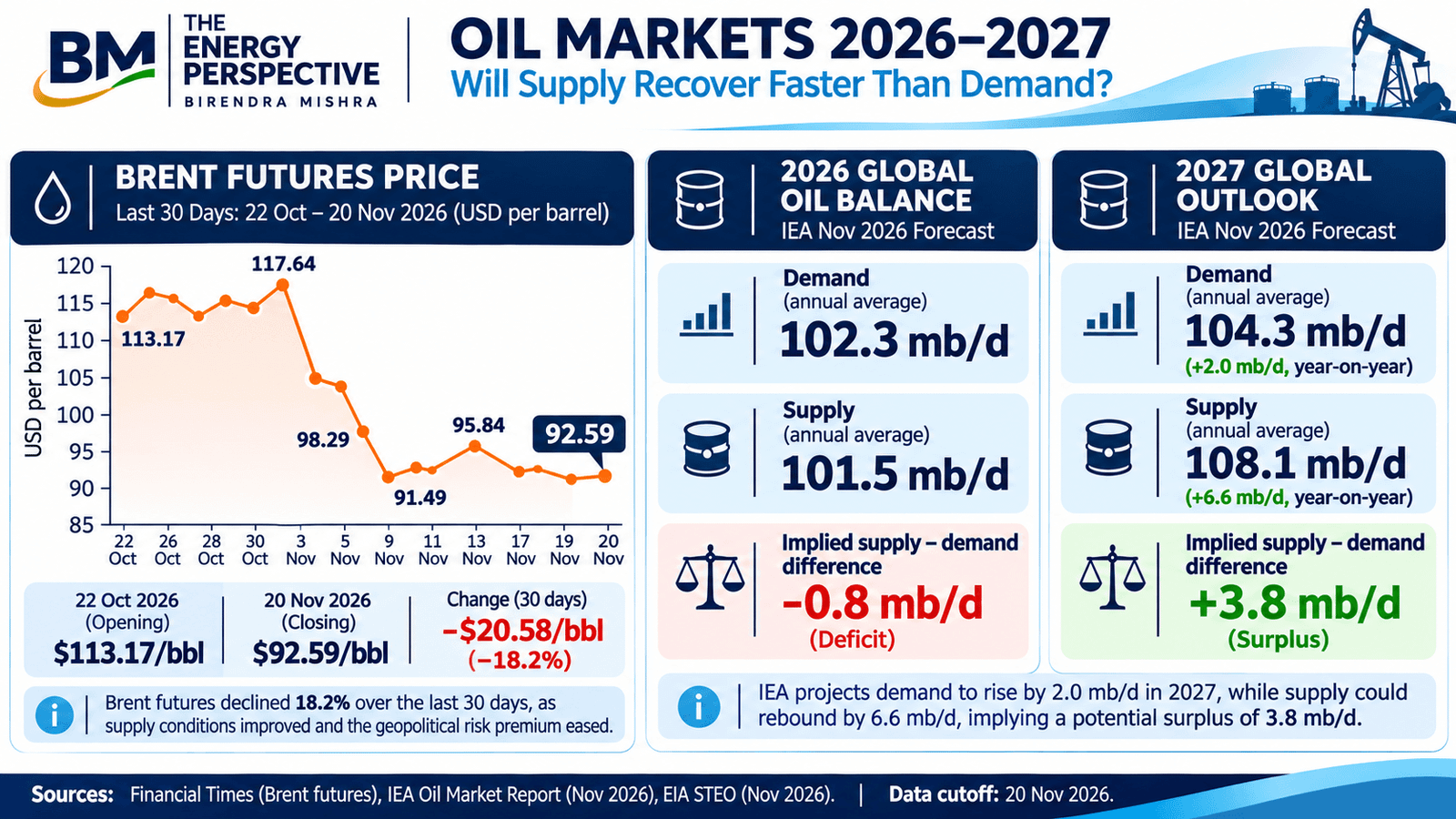
After one of the most disruptive years in modern energy history, physical oil markets are beginning to reprice. ICE Brent front-month futures closed at $92.57/bbl on 20 November, down $20.60/bbl from $113.17/bbl on 22 October as Middle Eastern export flows resumed through the Strait of Hormuz.
Beneath the surface, however, agency forecasts point toward a sharp structural reversal. According to the IEA’s November 2026 Oil Market Report:
- 2026 Estimate: Global oil demand contracts by 2.7 mb/d to 102.3 mb/d, against implied annual supply of approximately 101.5 mb/d (an estimated annual deficit of 0.8 mb/d).
- 2027 Forecast: Demand recovers by 2.0 mb/d to 104.3 mb/d, while supply is projected to rebound by 6.6 mb/d to 108.1 mb/d, shifting the market into a potential 3.8 mb/d annual surplus.
The U.S. EIA’s November Short-Term Energy Outlook mirrors this trajectory, projecting global inventories to build by 3.5 mb/d in the first half of 2027. By contrast, OPEC’s November Monthly Oil Market Report anticipates 2.6 mb/d of demand growth in 2027, a 0.6 mb/d (219 million barrel) disagreement that underscores how sensitive 2027 balances remain to macroeconomic assumptions.
Here is how this divergence plays out across the five principles of followed by the Energy Perspective from Birendra Mishra:
Principle 1 | Markets & Geopolitics
The market is transitioning from physical scarcity to supply-chain recovery risk.
Restoring shut-in production capacity is not synonymous with restoring frictionless global supply. While Gulf crude exports surged in October, pushing global supply to 105.4 mb/d and driving an 86 mb build in oil on water, maritime security threats in the Red Sea and Strait of Hormuz, elevated freight rates, and constrained Iranian shipments keep prompt risk premiums alive. Moreover, downstream bottlenecks persist: even as crude retreated from October highs, European diesel remained near $180/bbl (77% above pre-conflict levels), requiring IEA emergency stock releases to bridge the refining gap.
The critical variable for 2027 is not nominal OPEC+ spare capacity, rather it is the physical reliability of maritime corridors and global refining throughput.
Principle 2 | Finance & Investment
A faster supply recovery will test capital allocation discipline and downstream buffers.
Energy producers generated substantial cash flows during 2026’s price spikes, but 2027 presents a normalising margin environment. The EIA projects Brent spot prices to fall below $90/bbl in Q2 2027, averaging $81/bbl for the full year and declining toward $77/bbl by Q4 2027.
For CFOs, this compression forces three immediate trade-offs:
- Self-Financing Thresholds: Can operating cash flow fund planned 2027 CapEx if crude settles in the high $70s while oilfield service costs remain sticky?
- Distribution Durability: Will free cash flow cover base dividends and share buybacks without tapping balance sheet liquidity?
- Integrated Cushioning: For integrated majors, elevated petroleum product crack spreads in early 2027 will partially offset softer upstream realisations.
Capital discipline, sub-$40/bbl full-cycle project break-evens, and balance sheet liquidity will matter far more in 2027 than chasing volumetric growth.
Principle 3 | Energy Transition
The composition of oil demand matters as much as its headline growth.
The IEA expects roughly 80% of 2027’s 2.0 mb/d demand recovery to come from petrochemical feed stocks, specifically LPG, ethane, and naphtha, while road transport fuels contribute only modest growth. Electrification and fleet efficiency are structurally dampening gasoline and diesel elasticity, whereas petrochemicals, aviation, and maritime fuels remain tied to industrial and emerging-market expansion.
Energy transition strategy must move beyond aggregate oil demand forecasts and focus on product-level barrel composition and refining configuration.
Principle 4 | Innovation & Technology
Technology is compressing unit costs on both sides of the balance.
On the supply side, automated drilling, reservoir digital twins, and AI-driven predictive maintenance are lowering lifting costs and extending plateau production in mature basins. On the demand side, EV adoption, grid storage, and industrial electrification are steadily reducing oil intensity per unit of GDP. Yet in a lower price 2027 scenario, technology investments face stricter capital scrutiny.
Upstream R&D and digital budgets will be judged strictly on near-term cash conversion and unit-Opex reduction rather than long term optionality.
Principle 5 | Leadership & Strategy
2027 will test strategic discipline more than 2026 tested operational resilience.
Supply shocks and $100+ crude temporarily mask high cost structures and weak capital efficiency. A market shifting from a 0.8 mb/d deficit to a 3.8 mb/d surplus rapidly exposes differences in asset quality, hedging execution, and leverage. Leadership teams must navigate a bimodal distribution: an accelerated supply rebound that compresses margins toward $75–$80/bbl, or renewed Middle Eastern infrastructure strikes that reignite volatility.
The strongest leadership teams will not be those that forecast the exact 2027 Brent average, but those that structure portfolios to stay free-cash-flow positive across both extremes.
The CFO Perspective
Global oil markets are pivoting from a year defined by supply disruption to a year governed by the speed of supply recovery. In 2026, the core question was whether enough barrels could clear maritime choke points; in 2027, the question becomes whether global consumption, heavily reliant on petrochemical feed stocks, can absorb 6.6 mb/d of returning supply without triggering sustained price compression.
My central conclusion: The primary risk for 2027 is not a collapse in energy consumption, but a timing mismatch between rapid upstream supply restoration and structurally slower transport-fuel demand growth.
A question for energy leaders:
If global oil supply rebounds more than three times faster than demand in 2027, should energy CFOs prioritise balance sheet deleveraging, lock in downside price hedges now, or maintain shareholder buybacks?
#TheEnergyPerspective #tEP #EnergyMarkets #OilAndGas #BrentCrude #EnergyFinance #CapitalAllocation #EnergyTransition #CFOInsights